The War Against Iran is Killing U.S. Hegemony

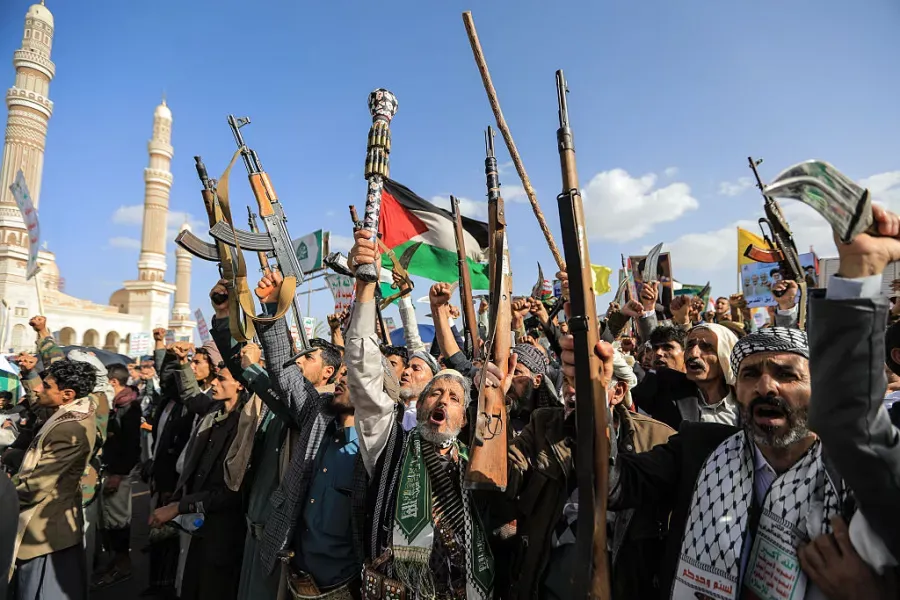
In this new iteration of my newsletter, I’m hoping that each dispatch connects at least somewhat to the one before, rather than being a semi-random string of emails connected to current events, but not to one another. In that vein, today’s newsletter will very clearly pick up where the last one left off. Last time I talked about the pending economic crisis, and since then there has been no change in the economic course of events. Trump has tried, with some success, to manipulate the stock market away from collapse, but the underlying economic problems of oil prices, fertilizer shortages, helium costs and more persist.
Today I want to focus on an immensely significant aspect of this rolling catastrophe that I only touched on briefly in the last dispatch – the petrodollar. In my previous newsletter I quoted Laleh Khalili, discussing how the end of petrodollar, and the beginning of the end of U.S. hegemony, could both be on the horizon. Talking to Democracy Now!, Khalili discussed how Iran has moved to threaten the petrodollar by only allowing tankers through the Strait of Hormuz if they purchase oil in yuan, the currency of China. What I didn’t have time to explain last time is how there is very likely a straight line between this decision and the decline of the U.S. empire.
For the past fifty years the petrodollar has been a pillar of U.S. hegemony, one I’d wager most Americans have never heard of. There are several of these quiet mechanisms of international finance and trade whose effects we take for granted, even as we’re unaware of them and their function – namely propping up the dollar and the financial power of the United States. Sanjay Turi sums it up when he writes, “Every nation that imports oil must accumulate dollars, which in turn feeds demand for US Treasury securities and underpins the depth and liquidity of American financial markets.”
I can only give you a cursory history here, but I think I’ll be able to cover the basics. In 1971, the United States ended the dollar’s convertibility to gold. This had been the backbone of the Bretton Woods international monetary system of fixed exchange rates where international currencies were pegged to the U.S. dollar, which in turn was based on a constant gold price. The uncoupling, conducted as a result of mounting trade deficits and dwindling gold reserves, led to significant economic instability, inflation, etc. One of the subsequent moves the U.S. made to continue international economic dominance and stability, particularly in light of the oil shock of 1973, was negotiating the inception of the petrodollar in 1974.

As Hung Tran writes, the U.S. wanted to get Saudi Arabia to use “the dollar as the medium of exchange for its oil sales, (and thereby funnel those dollars back into Treasury bond markets to help finance US fiscal deficits)” and in return “Washington promised to supply military equipment to Saudi Arabia and protect its national security.” Daragh Cogley spells it out even more simply, saying that after a secret deal was struck between the two countries in 1974, oil exports, first from Saudi Arabia (and later OPEC broadly) “have been priced in U.S. dollars" thus "ensuring a constant global demand for the dollar and U.S. Treasury assets.”
Oil is sold in dollars, so countries around the world always need dollars. Oil is sold in dollars because OPEC countries get the military might of the United States behind it in exchange for selling the most precious commodity on Earth exclusively in dollars. This both makes the dollar valuable and ensures its constant circulation. The dominant reserve currency (over 50% of the currency reserves in countries around the world) is dollars. Governments are, for now, willing to buy U.S. debt and invest in U.S. assets largely because of the dominant and persistent value of the dollar.
But, there are now multiple signs that this dominance may be coming to an end. Even before the American-Israeli war on Iran was launched at the end of February, China and Iran began planning for a move away from the petrodollar. As Sanjay Turi writes, “Iran and China have been building the financial infrastructure for yuan-denominated oil trade since at least 2018, when the US withdrew from the nuclear deal and reimposed sanctions.” Turi calls China’s Cross-Border Interbank Payment System “the architecture for a parallel, non-dollar energy corridor.” These are the sorts of financial mechanisms that undergird the world economy, but that most people have no knowledge of. And now China’s architecture is beginning to see higher volumes of cash flow, suggesting that it is purchasing oil from Iran or elsewhere outside the petrodollar.
Even though few ships are currently making it through the Strait of Hormuz, Iran has formally initiated a seismic shift with their new toll plan for this crucial bottleneck of global trade. Chinese yuan is now being used to pay tolls for passage through the Strait, according to Bloomberg. If Iran affects a full shift in all oil moving through this passage, and if the tankers moving through one day return to their full pre-war flow, 20% of the world’s oil will be paid for in yuan, taking a huge chunk of petrodollar dominance off the table.
Perhaps equally important is the other half of the petrodollar equation. You’ll recall that Saudi Arabia was initially willing to embark on this scheme with the United States, followed by other OPEC countries, in exchange for U.S. protection and weapons. That protection isn’t quite working right now. Iranian missiles, and drones even more so, are wreaking havoc on numerous OPEC countries. The U.S. interceptors are certainly taking out much of the Iranian salvo that is constantly being launched at these Gulf nations, but plenty of attacks are also getting through, hurting these countries’ economies, the American military bases they house, and most importantly the broader sense of safety that Gulf countries once felt under the umbrella of U.S. protection.
And so OPEC loyalty to the petrodollar is being tested. If modern drone warfare has rendered the American promise of safety less valuable, and if there is more money to be made over time by shifting from the dollar to the yuan, the entire international petrodollar scheme may be unraveling before our eyes, due primarily to a needless, disastrous war. For now the collapse of this pillar of the U.S. empire remains slow, but as this war continues and the global economy begins to falter before our eyes, the deterioration of the petrodollar, and of U.S. hegemony, could accelerate.
I should say that there are opposing views here. I’m most inclined to read those who see the U.S. empire unraveling right now, due to Iran, Trump, Israel and more. There is little doubt in my mind that this war will go down in the long-run as one of the biggest blunders of a failing empire. But I try, on occasion, to read those I disagree with. Patrick Foulis recently published something in the Financial Times that caught my attention. He writes that, for the obvious flaws and fallout of this war, “America’s strengths have [simultaneously] been on awesome display.” The raw destructive power of our thousands of bombs have decimated parts of Iran and its military, he says. And despite the asymmetrical nature of this war, and features of modern warfare that our military still appears unprepared for, the sheer force unleashed by the U.S. and Israel is terrifying to countries around the globe.
Foulis notes another important thing, which is that even as U.S. military actions destabilize the world economy, they have relatively less impact at home. The U.S. is a net exporter of energy after years of ramping up oil and natural gas production. Gas prices might be going up here, but compared to other countries we still have it good. And the American liquid natural gas industry's position is now the best on Earth as well. And while I think Foulis is overly optimistic about the war ending soon, he makes one other important point that must be noted: “After the war, however it ends, the Gulf countries, and perhaps Europe, will seek major investments in air defence.” And they will send billions to the U.S. in those investments. American dominance over military tech and power could be cemented by this war rather than decimated. Despite the weakened power of the petrodollar, the sheer force and willingness to use it, combined with our massive investments in the military industrial complex, could bolster a key facet of our dying empire’s hold over the globe.
On the other hand our military prowess, and its perception around the globe, appear more and more likely to deteriorate as this war continues. If Trump invades Iran fully, with boots on the ground, we could see countless U.S. troops die for no reason. This war is already historically unpopular, and the death of thousands of soldiers for nothing could turn this country against military adventures in a way we haven’t seen since Vietnam. Perhaps more important for the raw power of the empire, the U.S, military’s failure to adjust to the realities of asymmetric warfare, and drone warfare in particular, are already being exposed. A $200 million plane has been shot down, $2000 drones are striking American bases, and a prolonged war could just expose more of these flaws in the current state of U.S. military might.
Foulis fails to fully account for how Iran war has already begun to change the calculus, both around the petrodollar and around the U.S. as the ultimate financial safe-haven for investors around the world. As Aaron Brown writes for Bloomberg, “The petrodollar loop was always a political arrangement dressed in financial clothing. Now that the politics have changed, the finance is following.” Countries are selling U.S. treasuries, meaning they’re offloading U.S. debt rather than buying into it during this time of crisis. In many past crises the exact opposite happened, but this time the U.S. government is no longer looked at as the ultimate safe spot to park your cash. It’s hard to know what comes next. Trump gives relentless mixed signals, seemingly focused more on stock market manipulation than any clear objective in Iran, likely because he has no clear objective. But despite all the noise, one of the results that seems clearer by the day is that this war will mark a pivotal point in the trajectory of the U.S. empire.
We’ve taken our empire for granted here. Some Americans have cheered it on, of course, glorifying imperialism and assuming that every bomb we drop across the Global South is justified. Simultaneously, many of us have protested, from the Iraq War to Vietnam to the ongoing struggle against U.S. support for genocide. But the quiet pillars of empire have largely gone unnoticed among the general population. Mechanisms like the petrodollar have become embedded into global finance, and those of us who benefit most from them are often unaware of their existence. The empire prefers it this way – ideally every structural pillar of the empire is regarded as a fact of life, safe from consideration or relitigation. But this blunderous Iran War has managed to not only launch the petrodollar back into the spotlight, it has begun to break this all-important mechanism.
We’ve known for some time that the empire is declining. Our economy no longer makes things, by and large we’re a nation of financial capital and service work. But the world is still organized around us. Financial markets, oil, military might – inertia means it’s hard for the direction of a giant object in motion to be changed. And yet it’s changing. The energy, the force expended in Iran is changing the trajectory of this empire. In all likelihood we will see the economic effects of the war come home in a massive way in the coming months. And although it may take years to see the deep structural effects of the erosion of the petrodollar, and the effects of the broader erosion of U.S. hegemony, those will begin coming home to roost in the coming years as well. Then we'll really know what it means to live in interesting times.
Thank you for reading this today. I initially set out to write a little more here about what it'll mean to live in an empire that is no longer, but I got caught up on the particularities of the petrodollar and its load-bearing capacity to undergird U.S. power and wealth. I hope some of the links I provided fill in any gaps around the petrodollar itself, and next time I’ll write more about living through the crumbling of an empire, I think. Until then, JP.