Is the Pope a Marxist? Maybe.

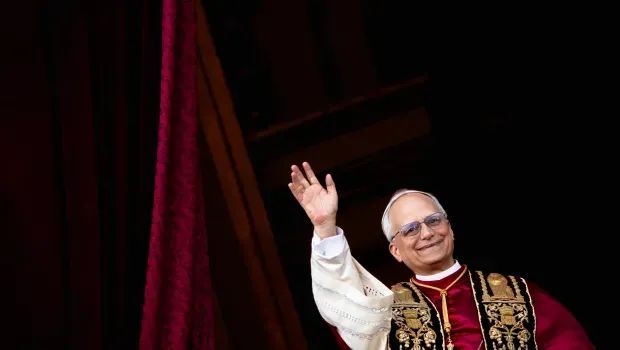
In the midst of an uncertain truce, with the eyes of the world still looking to see if a recession is around the corner, a somewhat surprising figure has emerged as the most prominent global advocate for peace. Maybe we shouldn’t be shocked, after all he speaks somewhat like his predecessor, but it’s more than just the fact that the first American Pope is preaching peace – it’s the way he relentlessly, firmly, and even radically pushes for justice, despite frequent criticism from the most powerful man on Earth.
Pope Leo has emerged as the most prominent global voice both against the senseless war in Iran and against the vast inequality that permeates society, and he is now the most respected public figure by the American public. He’s not the most powerful voice – the Iranian military would likely be the most powerful actor standing against this war at the moment – but the Pope commands the attention not just of the world’s 1.4 billion Catholics, but also of millions and even billions of others around the world. And, contrary to what some speculated when he was chosen, Leo has chosen to use his bully pulpit to preach a gospel that is anything but conservative.
As Joshua McElwee says for Reuters, Pope Leo “maintained a relatively low profile for a pope during the first 10 months of his papacy.” Then came the US-Israel war on Iran. On March 1st, right after the bombing of Iran began, Leo spoke to thousands of pilgrims at the Vatican, and prayed for peace. His speech was not radical. He spoke of the need for harmony, justice, and peace rather than war and domination. But that was enough for him to join the long list of people that Donald Trump chooses to criticize and attack.
It wasn’t just the Pope’s comments against war, and for peace that drew Trump’s ire. It was Leo’s comments calling the treatment of immigrants “extremely disrespectful,” much like his predecessor. But the Iran War, and Trump’s threats to destroy an entire civilization in particular, brought this all to a head. Leo responded to that abhorrent threat by calling it "unacceptable" and urging citizens to "contact the authorities — political leaders, congressmen."
We could go through the blow-by-blow, but there’s something much more important here, to me. And that’s Pope Leo putting forward a radical, spiritual vision opposed to war and inequality, one that isn’t new to many Catholics, but one that has certainly not seen the spotlight quite like this for some time, and is sorely needed right now. Leo’s rhetoric has grown in strength to meet this moment of senseless war and massive greed.
Some of his strongest recent statements include, “Woe to those who manipulate religion and the very name of God for their own military, economic, and political gain, dragging that which is sacred into darkness and filth,” and even, “[God] does not listen to the prayers of those who wage war, but rejects them.” Then there’s what might be my recent favorite:
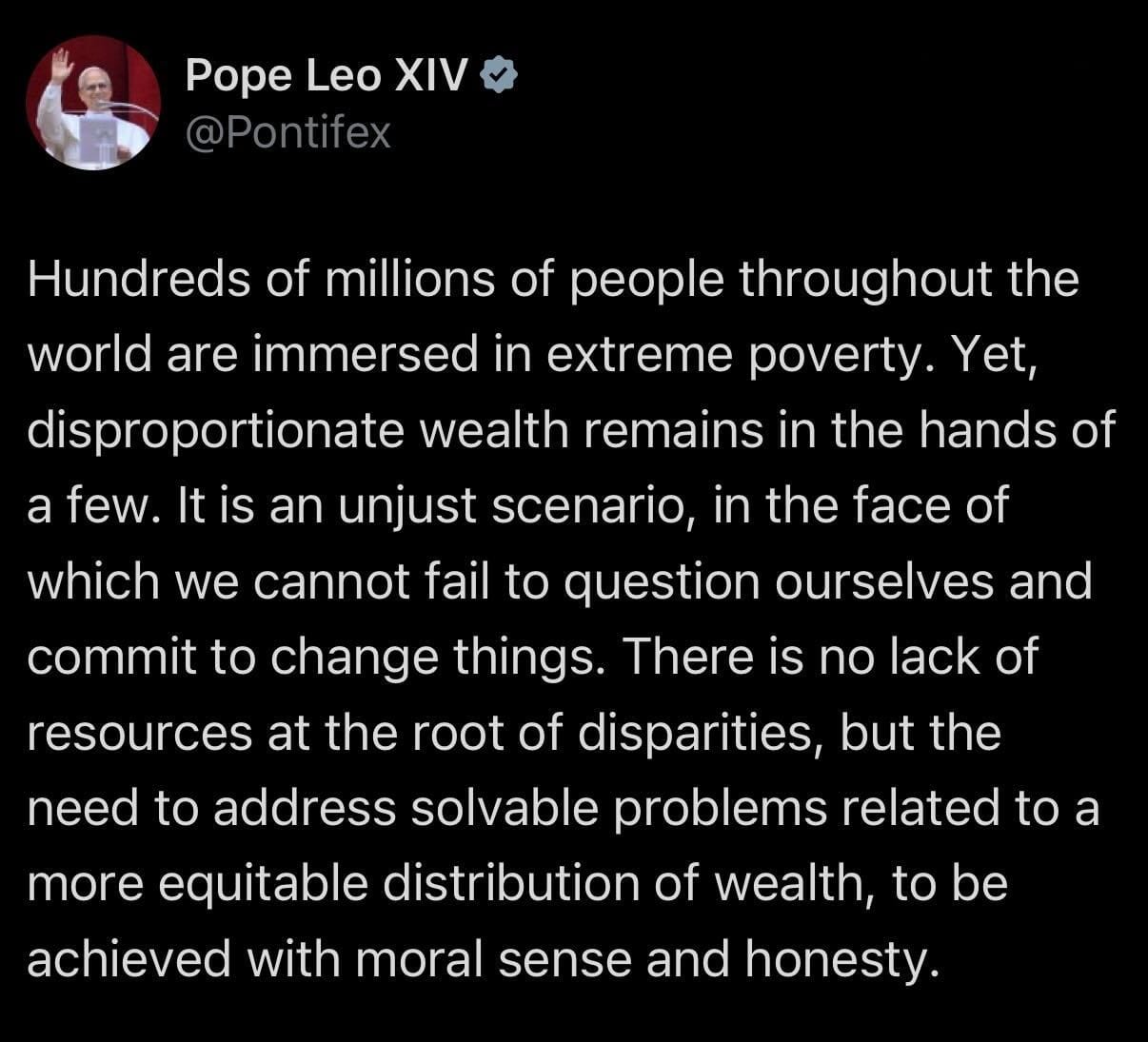
He’s now regularly speaking against war and the mass inequality of our world. He recently warned that “we’re in big trouble” if Elon Musk becomes the world’s first trillionaire. It’s hard to argue with that. As the Pope mentioned in another comment, “This view of justice is both simple and radical,” and if you’ve been reading me for even a little while you won’t be surprised that I’m drawn to what he’s been saying. Again and again Leo has been saying and insinuating that it’s this global inequity that de-stabilizes our society, that the hoarding of the few is intertwined with the absence of peace in our world. And I couldn’t agree more.
Of course for the Pope much of this is grounded in scripture. As Leo repeatedly emphasizes, he isn’t ‘doing politics’ as he sees it, he’s simply carrying the message of Jesus. It’s noteworthy that for much of the Pope’s career he was in Peru, he spent so much time there that he’s a Peruvian citizen, and in this time he was undoubtedly influenced by the Liberation Theology that pervades much of Latin America.
The seminal text of Liberation Theology was written by a Peruvian theologian and priest, Gustavo Gutiérrez. Entitled A Theology of Liberation, the 1971 book brought together Catholic Teachings and Marxism. Many of the comments you can find in the media about the Pope’s many years in Peru read like the following from Natalia Imperatori-Lee in Reuters: "In rural Peru, Prevost... was immersed in what poverty, corruption, globalization of indifference, climate catastrophe, (and) governmental violence does to people … He's uniquely qualified to speak about the dangers of... political corruption and violence.” This general take has plenty of truth to it, but it doesn’t include the vital and radical strain of Catholic teaching that influenced Leo’s theology dramatically. You need to go a little further off the beaten path and into Catholic news sources to see how liberation theology shaped Leo’s values and approach.
In the National Catholic Reporter, Justin Mclellan writes about how Latin America shaped this Pope. He notes that when Leo was in Peru the Latin American church was (finally) coming around to Gutierrez’s notion of "the preferential option for the poor." This profound idea can be boiled down to something Gutierrez said near the end of his life, which is that “God loves the world and loves those who are poorest within it." He believed that lifting up the poor was not a matter of charity, but that God sides with the downtrodden and that Catholics ought to concern themselves primarily with changing society such that we eradicate poverty.
The array of profound teachings from Gutierrez is endless. His writing and preaching, not to mention that of the many priests and thinkers who took to Liberation Theology in Latin America and beyond, is invaluable. We can learn a little more about his teachings by reading the following quote from the man himself: “The poor are a by-product of the system in which we live and for which we are responsible. They are marginalized by our social and cultural world. They are the oppressed, exploited proletariat, robbed of the fruit of their labor and despoiled of their humanity. Hence the poverty of the poor is not a call to generous relief action, but a demand that we go and build a different social order.” Gutierrez was heavily influenced by Marx, and we can see that both in his language and in the ultimate conclusion that we must build a different society. The traditional model of Catholic charity was not enough for him, and should not be enough for any of us. It’s not enough to help the poor, we must travel upstream and address capitalism and the roots of poverty.
Much has been written about liberation theology, and in my studies I’ve only scratched the surface. What I can tell you, definitively, is that less than six months into his tenure, Pope Leo wrote his first major papal document, which reads: “I am convinced that the preferential choice for the poor is a source of extraordinary renewal both for the church and for society.” For an institution with a long history of being enmeshed in colonial exploitation, of siding with conservative and oppressive regimes in Latin America and elsewhere, of hoarding wealth and of immense charity to now be led by a man who comes down firmly and decidedly on the side of the poor and oppressed is of great significance.
Today many people are understandably relishing a global figure with a larger pulpit than any other standing up to Trump, standing up for immigrants, and standing against war. But Pope Leo’s contribution, which has hopefully just begun, is reaching and will reach much further than being the anti-Trump. His lineage and many of his recent statements put forward a much broader vision, one that not only opposes one man’s ego and despotism, but that calls on Catholics, and on all of us, to forge a better world. On Tuesday he published a new, powerful call not just to peace but to transformation:
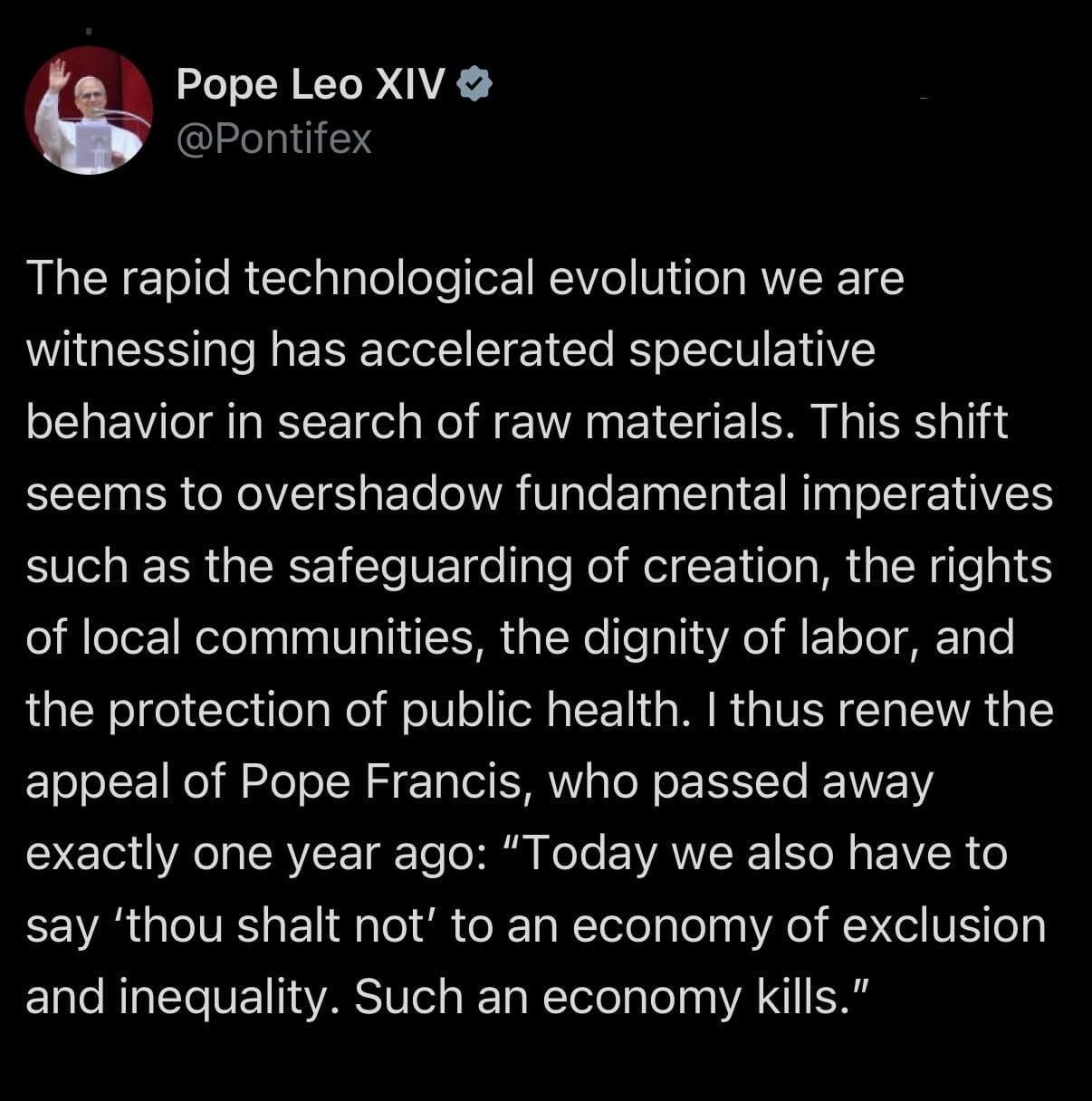
I have long thought that an injection of spirituality is one of the core elements needed on the left. More precisely, we’ve often lacked a call to our higher selves, a call that ties the work of bettering society to the forces beyond the everyday. Further along in the statement cited above, Leo says “the proliferation of armed conflicts is often driven by the exploitation of oil and mineral deposits” and then he follows that with “[God] must never be invoked to justify death-dealing choices and actions.” He discusses the material reality of our political world in concrete terms, but also invokes faith – perhaps the most powerful mover of human emotion and action.
I won’t ever become a Catholic, but that’s neither here nor there. The message Pope Leo is putting out isn’t perfect, and we all know the church is anything but, and at the same time he’s clearly leading a needed charge. A deeply rooted opposition to inequality, and opposition to war, a spiritual vision for a healthier and more just society – we all need this at the forefront of our thinking and our politics now more than ever.
The question is not should we all crown the Pope as our avatar, our leader, the question is how we take what he’s offering and run with it. How do we fight for a better world, how do we build the “counter-current” politics that Leo is now discussing, and how do we bring more and more people with us to ground this fight in values that we all hold? That’s a crucial part of our work, and the Pope has now taken up that torch and a powerful, needed way. A way many of us should give some thought to, should consider taking hold of and running with.